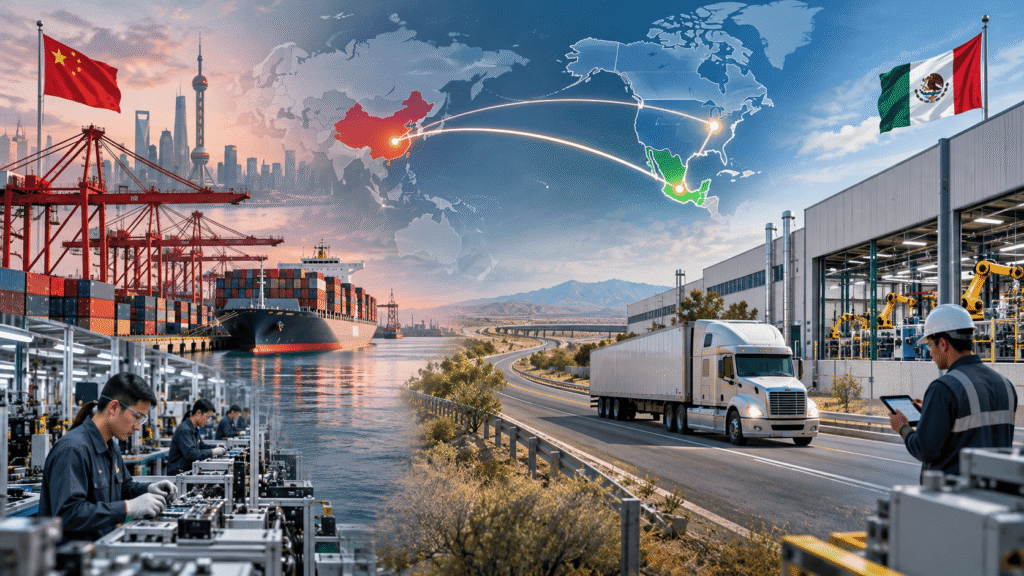
Under USMCA, goods can cross North American borders at reduced or zero tariffs, provided they meet the rules of origin and the importer’s claim stands up to customs checks.
What Is USMCA?
The USMCA (United States-Mexico-Canada Agreement) is a free trade agreement between the United States, Mexico, and Canada that took effect on July 1, 2020. It establishes common trade rules, reduces barriers to cross-border commerce, and allows qualifying goods to receive preferential tariff treatment.
Unlike its predecessor, NAFTA – the North American Free Trade Agreement set in 1994 with an indefinite lifespan – USMCA contains a 16-year sunset clause coupled with mandatory joint reviews every 6 years.
How Goods Qualify For Tariff Benefits Under USMCA Rules Of Origin
To receive reduced or zero tariffs (customs duties), goods must meet category-specific criteria – the ‘rules of origin’ – which determine whether they qualify as originating in North America. Qualification can depend on the amount of regional materials a product contains, the manufacturing and processing steps involved, or both.
Products made with materials or components from non-member countries can still qualify, provided they meet the applicable North American content and production requirements – a key factor in nearshoring decisions.
The USMCA Trade Agreement After The 2026 Review
Following its July 2026 joint review, USMCA was not renewed outright, triggering a cycle of annual joint reviews until a mutual agreement is reached, while its core terms remain unchanged.
Currently, Washington pushes to stop Chinese goods from being transshipped to North America through Mexico and Canada, urges the latter to fulfill its market-opening commitments for U.S. dairy imports, and opposes Mexican energy policies that favor state firms over USMCA partners, a concern Canada has also raised.
Rules of origin for certain automotive goods, steel, and aluminum are under active negotiation, alongside broader talks on supply-chain resilience, including critical minerals largely processed in China.
Separately, U.S. tariffs on a growing range of products already apply to Canadian and Mexican goods, in some cases even when they qualify under USMCA.
USMCA Rules Of Origin
USMCA rules of origin are legal criteria that determine whether goods traded between the USMCA countries (the U.S., Mexico, and Canada) qualify for preferential duty-free or reduced-tariff treatment.
USMCA Origin Criteria
USMCA’s Article 4.2 sets out four ways for goods to qualify as originating:
- Wholly obtained or produced goods – Criterion A
Goods obtained entirely within USMCA countries, such as crops grown there, minerals extracted there, or animals born and raised there. - Goods made with non-originating materials – Criterion B
Goods made within the region using materials that do not already qualify must meet product-specific rules. These may require a tariff shift, minimum regional value content, particular manufacturing processes, or a combination. The same rules apply to manufacturers working with shelter companies in Mexico. - Goods made exclusively from originating materials – Criterion C
Goods manufactured within the region entirely from materials that already qualify under USMCA. - Limited tariff-shift exceptions – Criterion D
Certain goods made within the region can qualify despite failing a required tariff shift, provided they meet specific customs classification conditions, regional value thresholds, and other requirements.
Supporting Rules: Accumulation & De Minimis
Two supporting rules help determine whether goods qualify under USMCA.
- Accumulation: Qualifying materials and production across the three member countries can count together toward meeting origin requirements.
- De minimis: Under the general de minimis rule, materials that fail the required tariff shift can generally account up to 10% of either the finished product’s transaction value (excluding international shipping costs) or its total production cost.
Exceptions and other requirements apply, including separate provisions for textiles and automotive goods.
USMCA Requirements
Once goods meet the applicable rules of origin, USMCA traders must document and claim preferential tariff treatment under the origin procedures in USMCA Chapter 5.
USMCA Certificate
Claims generally require a certification of origin, often called a USMCA certificate of origin.
Unlike the former NAFTA trade framework, the USMCA agreement does not mandate an official government form.
It can be completed and signed by the importer, exporter, or producer on a commercial invoice or any other document, provided it contains the nine minimum data elements set out in Annex 5-A:
- Certifier Type: Specification of whether the certifier is the importer, exporter, or producer.
- Certifier Information: Full name, title, company address, phone number, and email.
- Exporter Information: Details of the exporter, if different from the certifier.
- Producer Information: Details of the producer, or “Available to customs upon request” if confidential.
- Importer Information: Details of the importer, if known.
- Description and Tariff Classification: Clear description of the merchandise and its 6-digit HS tariff classification.
- Origin Criterion: The specific qualification pathway claimed (Criterion A, B, C, or D).
- Blanket Period: Date range (up to 12 months) if the certification applies to multiple identical shipments.
- Authorized Signature and Certification Statement: Date, signature, and prescribed legal certification statement attesting that the goods comply with origin rules.
Claiming Preferential Tariff Treatment
The importer claims USMCA treatment on the import declaration and, unless an exception applies, must hold a valid certification at that time and provide it to customs upon request.
When A Certification Of Origin Is Not Required (Exceptions)
Low-value commercial imports do not require a certification of origin if they are valued at no more than:
- CAD 3,300 in Canada
- USD 2,500 in the United States
- USD 1,000 (or the equivalent in Mexican pesos) in Mexico
Note that USD 1,000 is the treaty’s baseline, and each country may set a higher limit or waive certification entirely for certain goods.
Even below these limits, a signed statement of origin may still be requested, usually for repeat shipments from the same supplier or by customs brokers seeking legal cover.
Importers who deliberately split shipments to stay under these limits are typically asked to submit a certification of origin, and any false origin claim can carry penalties.
USMCA Certificate Of Origin: Recordkeeping & Customs Verification
USMCA claims must stay provable for set timeframes.
Retention Periods
Exporters and producers using USMCA tariff benefits must keep all records related to each shipment, including a copy of the certification of origin where one was required, for at least 5 years for goods entering the United States or Mexico, and 6 years from the import date for goods entering Canada.
Customs Checks
Throughout the retention period, customs officers may review bills of materials, production records, or cost calculations, or even, with the producer’s consent, visit the production facilities in another USMCA country.
Denied Claims
If the evidence does not support the claim, customs may deny preferential tariff treatment, and the importer must pay the difference between the duty already paid and the amount owed.
Staying On The Right Side Of USMCA Requirements
Every USMCA claim rests on paperwork that has to stay accurate long after goods clear the border, from the certification of origin to the import declaration.
At Loginam, our expert cross-border logistics team handles USMCA origin documentation in-house from our Tijuana facilities, about five miles from the U.S. border, so the records customs may request later match the goods that actually crossed.
Claim the savings. Keep the proof. Talk to our team today!