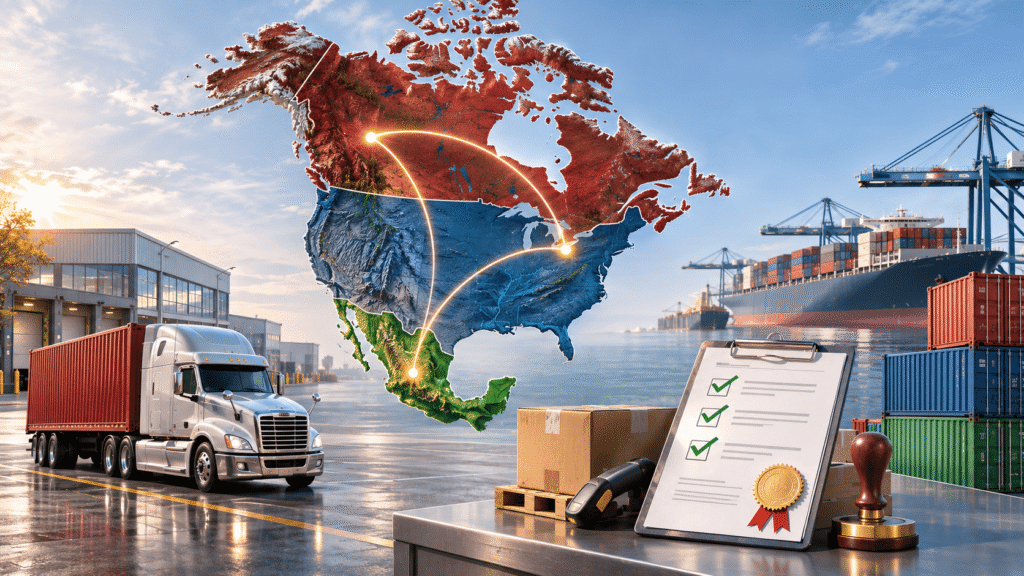
Global trade volatility and changing tariff policies are prompting North American businesses to reconsider how they structure their international supply chains.
What Is The China Plus One Strategy?
The China Plus One strategy is a corporate supply chain risk management framework in which an organization maintains its established primary manufacturing operations in China while establishing additional sourcing or production nodes in another country – often with lower labor or operating costs than China. The core objective is to reduce reliance on a single nation and hedge against localized operational disruptions.
In essence, China +1 builds extra operational capacity to protect global delivery networks against sudden trade policy shifts, currency swings, and shipping bottlenecks.
Who Started The China Plus One Strategy?
The China Plus One strategy originated in Japan. Indeed, Japanese industrial conglomerates were among the early adopters of this approach in the early 2000s, amid global procurement shifts, rising manufacturing costs in China, and growing diplomatic tensions between Tokyo and Beijing.
Japanese enterprises were thus faced with a stark reality: the risks of relying too heavily on a single country for production and sourcing. As a result, many began establishing secondary production hubs across Southeast and South Asia.
By 2013, the diversification approach had gained wider recognition across international supply chains. Expanding beyond a single manufacturing hub was increasingly recognized as a way to reduce operational risks without abandoning established Asian supplier networks.
More than a decade later, the strategy remains relevant. According to a 2026 survey, Japanese companies considering shifting production or procurement outside China identified India (32%), Vietnam (31%), Thailand (27%), Indonesia (22%), and the Philippines (16%) as potential destinations. Meanwhile, 47% considered reshoring operations back to Japan.
Is China Plus One Still Relevant In 2027?
Entering 2027, adopting a China plus one strategy for supply chain continuity is a core business priority amidst the volatile global trade landscape.
In the U.S., similar concerns are driving companies to reconsider their reliance on overseas suppliers. In fact, a recent survey of U.S. contract manufacturers found that 60% of their customers were discussing reducing reliance on China or Taiwan, 19% reported they were already shifting sourcing, and 53% cited geopolitical risks as a driver of their customers’ move toward domestic sourcing.
Among the surveyed U.S. OEMs, 57% named trade-policy uncertainty as their main challenge.
Why Is China Plus 1 Gaining Momentum?
The China+1 strategy is gaining momentum as companies seek to reduce their exposure to geopolitical tensions, rising labor costs, shipping disruptions, and increasingly complex trade regulations. In more detail:
Persistent Geopolitical Risks & Tariff Volatility
Evolving trade policies and higher import tariffs, particularly those affecting Chinese exports, continue to alter international cost structures. Importers face shifting duty rates that can instantly erode operating margins, prompting companies to establish secondary nodes in tariff-favorable regions.
Rising Labor Costs & Demographic Challenges In China
Chinese manufacturing wages have increased steadily over recent years, while demographic contractions reduce available factory personnel. As a result, China’s once-significant labor cost advantage has weakened, making alternative manufacturing locations increasingly competitive.
Vulnerability To Global Shipping Disruptions
Maritime port congestion, container shortages, and extended transit windows repeatedly threaten production schedules. Operating secondary manufacturing locations prevents localized logistics bottlenecks from halting global fulfillment.
Evolving Regulatory Compliance & Traceability
Modern border agencies enforce strict regulatory oversight regarding raw material origin, labor standards, and ESG (Environmental, Social, and Governance) compliance. Establishing secondary operations in transparent regulatory environments simplifies customs verification and protects corporate reputation.
China Plus One Manufacturing Strategy Benefits
Implementing a secondary manufacturing destination has substantial strategic and financial advantages for growing enterprises.
Operational Risk Mitigation & Business Continuity
Distributing manufacturing operations across distinct geographic jurisdictions reduces the risk of major delivery halts caused by regional lockdowns, weather events, or trade disputes.
Greater Agility & Market Responsiveness
Locating secondary production facilities closer to core consumer markets through nearshoring enables companies to respond to shifting demand, implement product design changes, and handle seasonal spikes with shorter lead times.
Total Landed Cost Optimization
By shifting final manufacturing to nations with favorable trade agreements, such as the USMCA for Mexico-US trade, importers can reduce import duties and potentially lower transportation costs, optimizing net operating margins.
Procurement Leverage & Supplier Flexibility
Maintaining dual sourcing capabilities grants procurement teams stronger positioning during contract negotiations, reducing dependence on single-vendor pricing models.
China + 1 Strategy – Challenges
Setting up a secondary production facility pays off most when companies plan ahead for the operational hurdles that come with it.
Freight Capacity & Transport Infrastructure Limitations
Emerging manufacturing destinations may possess smaller port facilities and limited air freight throughput relative to major East Asian gateways, requiring careful carrier capacity planning.
Extended Transit Times & Feeder Port Delays
Shipments originating from secondary regional hubs frequently rely on feeder vessels to reach major international shipping hubs, adding several days to overall transport schedules.
Inbound Material Sourcing & Component Dependencies
Relocating finished product manufacturing does not instantly create local networks of component and raw material suppliers. Initial operations often rely on imported components, requiring structured supply chain integration.
Facility Quality & Storage Limitations
Securing modern industrial space with adequate storage capacity and reliable infrastructure requires thorough site screening in rapidly expanding industrial markets.
Regulatory Nuances & Local Customs Compliance
Navigating distinct tariff structures, administrative filings, and local regulations involves a learning curve as companies adapt to new compliance requirements and local business practices.
Workforce Productivity & Cultural Dynamics
Labor availability, technical skill profiles, and statutory holiday structures differ across countries, requiring tailored operational planning and training programs.
How To Choose Your Plus One Location
Selecting a secondary manufacturing or sourcing destination requires careful evaluation of key operational factors.
| Evaluation Criteria | What To Consider |
| Total Landed Cost | Calculate total landed cost, including raw materials, labor productivity, freight forwarding, customs duties, and local taxes, rather than focusing exclusively on hourly wages. |
| Geopolitical Stability & Trade Policy | Assess national political stability, judicial consistency, and applicable trade agreements with destination markets to determine the level of operational security. |
| Logistics Infrastructure & Trade Access | Evaluate port access where relevant, highway networks, rail connections, and utility reliability to determine whether a region can support scaled industrial distribution. |
| Supplier Ecosystem & Local Capacity | Review the availability and capabilities of local sub-tier suppliers, along with manufacturing resources, to reduce dependence on long-distance component imports. |
| Labor Force & Education | Analyze workforce availability, technical training centers, and local employment legislation to assess labor supply and stability. |
China Plus One Strategy: Mexico & Its Competitive Advantages
For North American companies pursuing a China Plus One strategy, Mexico offers a compelling manufacturing alternative. Geographic proximity, established industrial infrastructure, and potential USMCA tariff benefits make it particularly attractive for businesses serving the US market.
Mexico already holds a significant share of US goods imports, accounting for 17.2% of US goods imports ($616.84 billion) in a 12-month period that ended in September 2026, compared with China’s 7.83% ($280.79 billion) over the same period.
Mexico also benefits from significantly lower average US import duties: 3.60% compared with 25.91% for China over the same period – with actual tariff rates varying by product.
Beyond these trade figures, Mexico offers several practical advantages for companies looking to establish a secondary manufacturing base:
- Faster Delivery to US Markets: Direct cross-border trucking can reach US distribution centers in days, compared with weeks for ocean freight from China.
- USMCA Tariff Benefits: Under the United States-Mexico-Canada Agreement (USMCA), goods that meet the applicable origin rules generally qualify for duty-free treatment, although additional tariffs may apply to certain products.
- Established Industrial Expertise: Mexico has established industrial clusters in automotive, aerospace, electronics, medical devices, and industrial machinery.
How To Make China+1 Work For You
Executing a successful geographic diversification plan requires careful planning and phased implementation.
| Step | How To Implement It |
| 1. Conduct An End-To-End Supply Chain Audit | Map all sub-tier suppliers to pinpoint sole-source vulnerabilities, regulatory exposures, and tariff impacts. |
| 2. Select High-Impact Pilot SKUs | Start with manageable products that offer clear tariff or sourcing advantages before migrating more complex product lines. |
| 3. Maintain Dual Sourcing Operational Capability | Keep baseline production active in primary hubs while scaling secondary operations to avoid disrupting customer orders during the transition. |
| 4. Partner With Local Logistics Experts | Engage experienced regional logistics, customs, and legal partners to navigate legal setup, customs compliance, and administrative filings. |
| 5. Follow A Phased Expansion Schedule | Expand production incrementally, verifying quality metrics and delivery timelines before increasing production volumes at the secondary location. |
Your China Plus One, Five Miles From The U.S. Border
Loginam is a Tijuana-based nearshore 3PL that combines shelter services, contract manufacturing, warehousing, and cross-border transportation in one integrated operating model, just 18 miles from downtown San Diego.
At Loginam, we support a steady transition for companies moving production out of China, piloting high-tariff SKUs in Mexico, or running dual sourcing alongside their existing Asian supplier networks while serving customers across the U.S. market.
Our in-house customs team and cross-border trucking lanes connect that setup to your U.S. warehouses and buyers, coordinating imported components, finished products, and customs documentation from the same Tijuana facility through delivery to U.S. customers.
Launch a resilient plus one, from the first pilot SKU to full-volume production shipped north. Talk to our team today!