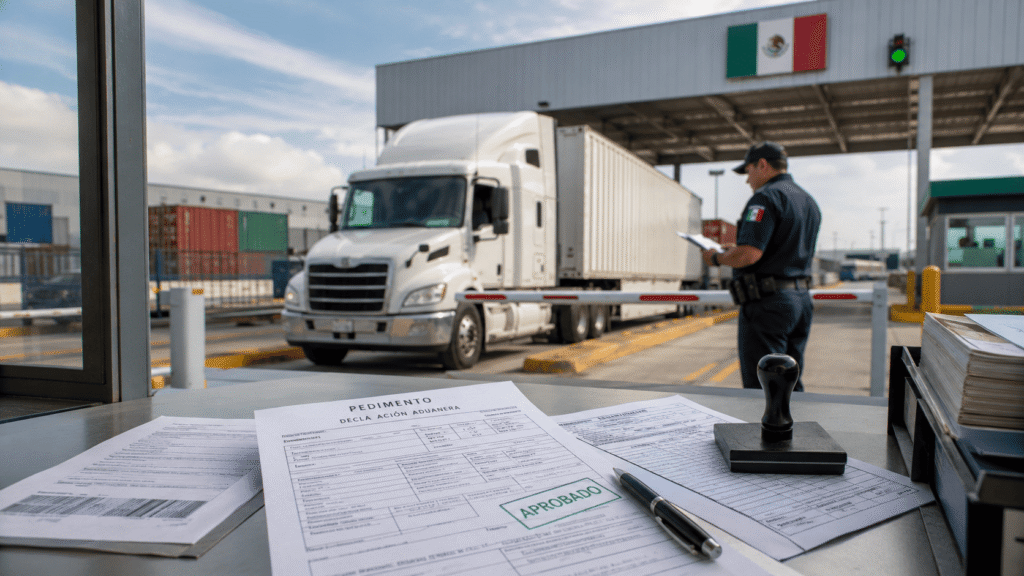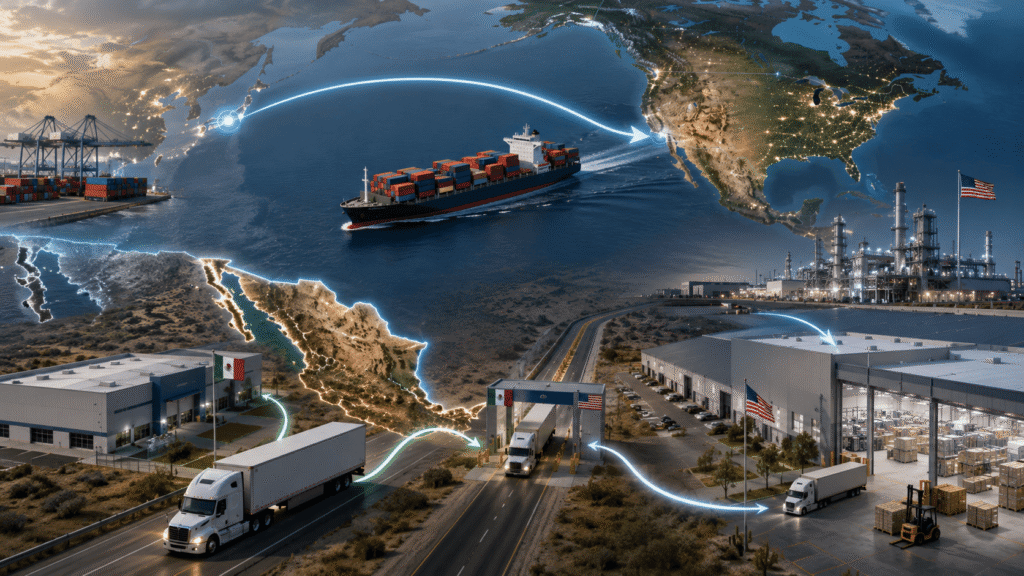
For American manufacturers, Mexico is no longer just a lower-cost production option. It is a strategic nearshoring base built around shorter lead times than overseas production can offer, closer operational oversight, and easier access to North American customers.
The real question is how to become operational without spending 9 to 12 months on permits, legal setup, and compliance infrastructure before a single product ships.
That is what Mexico shelter services were designed to solve.
TL;DR
- Mexico shelter companies let foreign manufacturers produce in Mexico under the provider’s legal entity and IMMEX program while keeping full control of production, quality, and intellectual property.
- Since Mexico’s 2020 tax reform removed the four-year limit, a shelter can be a long term strategy, as long as the shelter meets Mexico’s maquila tax requirements.
- Shelter companies in Mexico range from manufacturing campuses to administrative providers, so compare what each includes before comparing fees.
- A shelter fits companies that want production running before their own entity could be ready; contract manufacturing fits those who want a partner to run production.
What Is A Shelter Company In Mexico?
A shelter company in Mexico allows a foreign manufacturer to operate without immediately establishing a standalone legal entity in the country. Instead, a Mexican shelter company acts as an operational and regulatory host: it holds the permits, employs the workforce, handles customs documentation, and manages compliance obligations on their client’s behalf.
The client still controls all core operations, including production processes, product quality, equipment, engineering, intellectual property, and operating standards, while the shelter provider handles the administrative and regulatory burden around them.
A Faster Path Into Production
In practical terms, a shelter structure offers nearshore or overseas companies a faster path into production:
Instead of spending months forming an entity, applying for permits, building local HR, finding customs support, and coordinating vendors separately, they can operate under an established shelter framework designed for foreign manufacturers, especially those based in the U.S.
And because Mexico has a long history as an export manufacturing hub, with more than 6,513 active IMMEX programs currently running, foreign companies gain access to a mature, deeply embedded export manufacturing ecosystem from day one.
Shelter IMMEX And The Shift To Long-Term Operations
IMMEX (Industria Manufacturera, Maquiladora y de Servicios de Exportación) is the Mexican government framework authorizing duty-deferred temporary imports for export manufacturing.
Under IMMEX, a certified entity can bring raw materials, components, and machinery into Mexico without paying import duties, on the condition that finished products are exported. Inputs have an 18-month temporary import window; machinery can remain for the program’s duration.
Through the shelter, the certification is held on the client company’s behalf, giving them access to an already-certified framework without a months-long permit application.
Mexico’s 2020 Tax Reform To The Income Tax Law
A 2020 tax reform to Mexico’s Income Tax Law changed the shelter model in two important ways.
It removed the old four-year income tax grace period, so foreign companies now have Mexican tax obligations from the start of operations. It also eliminated the fixed four-year limit on permanent establishment protection. Companies can thus keep operating through a shelter structure indefinitely when the shelter meets the required tax rules.
In practice, the shelter must follow Mexico’s Safe Harbor tax rules to preserve that protection for the foreign company.
These rules set taxable income at the higher of two amounts: 6.9% of maquila assets or 6.5% of costs and expenses. Mexico’s 30% corporate income tax is then applied to that taxable amount.
Since 2025, Safe Harbor has become the standard compliance route for maquiladora operations after the older APAs (Advance Pricing Agreements) were phased out.
This is a core strategic point because shelter services in Mexico can now be treated as a permanent operating strategy, not just a temporary entry vehicle.
Types Of Shelter Companies In Mexico
Mexico shelter companies vary by operating model, asset base, permit structure, and level of support, so matching the right structure to your needs matters.
Manufacturing Campus Models
The provider typically owns or operates the facilities and coordinates workforce support, logistics, compliance, and administration through a single platform.
They act as a single point of coordination and offer a predictable path from decision to first shipment, especially when speed, scalability, and operational coordination matter as much as compliance.
Full-Service Shelter Companies
Full-service shelter companies deliver a broad scope of services, including IMMEX administration, HR, payroll, customs, EHS, and accounting, but they typically do not own real estate.
Instead, they help clients source and lease industrial space through an independent landlord, then layer their operational and administrative services on top.
Administrative Shelter Providers
Administrative shelter providers focus on the compliance and administrative wrapper, such as IMMEX support, payroll, tax filings, customs documentation, and related back-office functions.
Clients usually lease space independently and take more direct responsibility for facility management, vendor coordination, and local operating decisions.
Shared Shelter
Here, non-Mexican companies operate within a shared legal and IMMEX framework alongside other manufacturers.
Because the legal, administrative, and compliance structure is already in place, overhead is spread across multiple companies.
This can make the model faster to enter and more cost-effective at lower headcount, though with less operational separation than a dedicated structure, which can limit customization.
Dedicated Shelter
The shelter service configures a dedicated IMMEX authorization and operating structure. The Mexican legal entity remains owned and managed by the shelter provider, but the permit and compliance infrastructure is organized around a single operation.
Setup takes longer and costs more, but delivers greater operational separation, cost visibility, and reporting transparency. It’s a common fit for larger manufacturers, companies with sensitive IP, or long-term Mexico plans.
Sector-Specific Shelters
As the name implies, this type of service is tailored around the needs of specific industries, such as medical devices, automotive, electronics, or aerospace, where documentation, quality, supplier, and regulatory requirements can be more demanding and need specialized guidance on industry-specific standards.
Contract Manufacturing Hybrid
In this model, the provider or a local partner may manage production labor, shop-floor execution, or portions of the manufacturing process itself. This reduces operational complexity but means less direct control over production compared with a standard shelter arrangement.
It is best suited for companies that want operational simplicity more than direct shop-floor control.
Typical Services Provided By Shelter Companies In Mexico
Shelter services are not only about getting into Mexico faster. They offer much more:
Administrative Support
On the administrative side, a Mexican shelter service provider often acts as the Employer of Record (EOR), meaning they become the local legal employer for the workforce and manage HR responsibilities such as recruitment, onboarding, payroll, employee documentation, and benefits coordination.
This role also covers legally required employer obligations related to:
- IMSS (Instituto Mexicano del Seguro Social) – managing social security and healthcare contributions.
- INFONAVIT (Instituto del Fondo Nacional de la Vivienda para los Trabajadores) – administering mandatory housing fund contributions.
- SAR (Sistema de Ahorro para el Retiro) – coordinating retirement savings contributions.
- PTU (Participación de los Trabajadores en las Utilidades) – administering Mexico’s employee profit-sharing requirement.
- Aguinaldo – managing the mandatory annual Christmas bonus, which must equal at least 15 days of base salary and be paid to all employees before December 20 each year.
Beyond employer-related responsibilities, a Mexico shelter company may also serve as the local administrative backbone of a manufacturing or logistics-related operation, which may include: financial and back-office tasks such as payables controls, approval workflows, VAT recovery coordination, and financial reporting.
This allows foreign companies to operate in Mexico without having to build their own dedicated HR and finance infrastructure.
Compliance Support
A shelter company usually handles the legal, tax, customs, and regulatory work needed to keep the operation active and compliant. This often means dealing with:
- SAT (Servicio de Administración Tributaria) filings – reporting to Mexico’s tax authority and managing the monthly and annual filings required to maintain compliance.
- IMMEX permit maintenance – keeping export-manufacturing authorization valid, meeting reporting deadlines, and managing the thresholds required to avoid suspension.
- IVA/IEPS (Impuesto al Valor Agregado / Impuesto Especial sobre Producción y Servicios) certification management – maintaining the SAT certification that provides a 100% tax credit on VAT and IEPS owed on qualifying temporary imports.
- Customs documentation – managing import and export paperwork, tariff classifications, customs declarations, and other U.S.-Mexico cross-border filing requirements.
- Anexo 24 – maintaining Mexico’s automated inventory control system for IMMEX operations, which tracks temporary imports from entry through production to export or discharge.
- Anexo 30 / SCCCyG (Sistema de Control de Cuentas de Créditos y Garantías) – working with the credit and guarantee control system, formerly known as Anexo 31, which tracks VAT/IEPS credits tied to temporary imports.
- Inventory reconciliation – matching imported materials to production, tax-credit, and export records across Anexo 24, Anexo 30, and related customs systems.
- C-TPAT / OEA (Customs Trade Partnership Against Terrorism / Operador Económico Autorizado) certification support – coordinating U.S.-bound nearshoring and Mexican supply chain security certifications that can affect customs processing, inspection risk, and the facility’s customs profile.
- EHS (Environmental, Health, and Safety) compliance – addressing Mexico’s workplace safety standards, environmental obligations, site-level permits, and inspection requirements across municipal, state, and federal levels.
This is not just paperwork. Regulatory gaps can quickly become serious operational problems.
By keeping filings, records, and approvals in order, experienced Mexico shelter providers help protect production continuity and cross-border flow for U.S. companies.
Benefits Of Shelter Services For U.S. Manufacturers
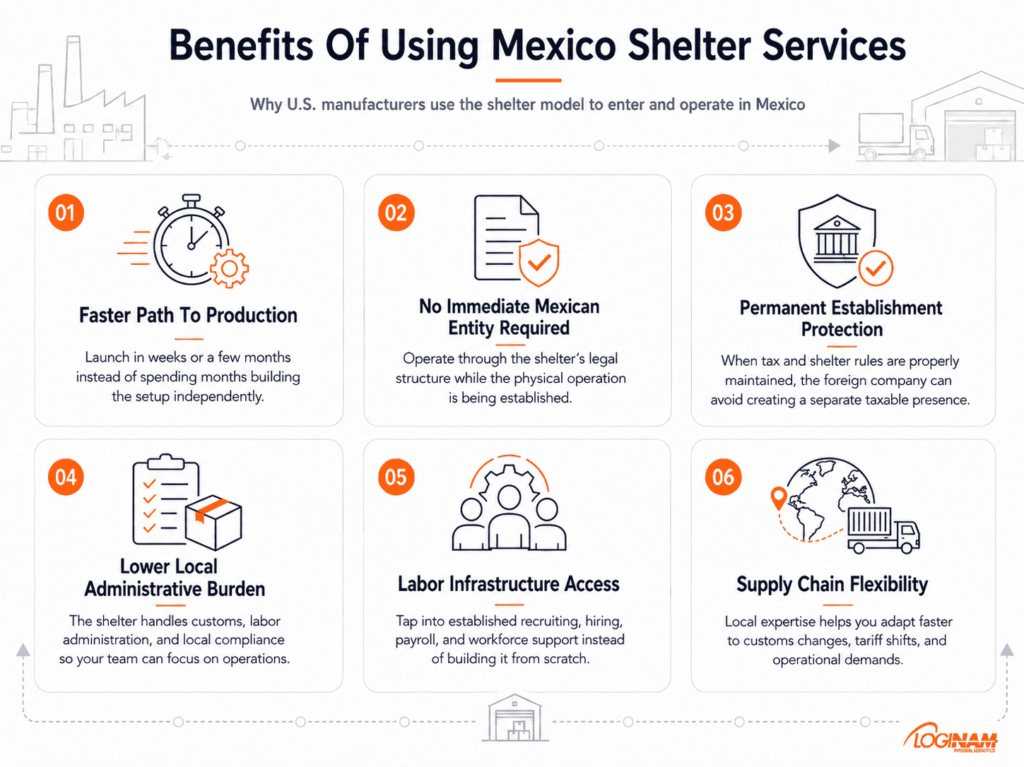
For U.S. companies, the main benefits of shelter services in Mexico come down to a faster, lower-friction way to start operating locally:
Faster Path To Production
Under an established shelter model, a U.S. or other overseas manufacturer may be able to move from contract signing to production in weeks or a few months, depending on facility readiness, equipment, headcount, and compliance requirements.
This can cut down on the additional months typically needed to form an entity, secure permits, build compliance infrastructure, and set up the operation independently.
No Immediate Standalone Mexican Entity Required
A foreign company can operate through the shelter’s existing legal structure instead of creating its own Mexican subsidiary before launch, simplifying market entry while the physical operation is being set up.
Permanent Establishment Protection
As long as the Mexican partner maintains the required shelter-regime, tax, and Safe Harbor compliance, the client business can operate through that framework without creating a separate taxable presence.
Lower Local Administrative Burden
Customs compliance, labor administration, environmental obligations, and other local requirements are handled through the shelter structure.
This gives the on-site team more room to focus on production, quality, and daily execution instead of building every local back-office function internally.
Labor Infrastructure Access
A shelter provider with deep regional recruiting experience brings established hiring processes, workforce support, and retention practices that a new market entrant would take time to build.
For example, consider a shelter company in Tijuana that operates inside one of Mexico’s densest border manufacturing markets, with more than 595 active manufacturing companies and over 259,000 skilled workers.
That local labor knowledge can make it easier to staff production, stabilize teams, and support ramp-ups without starting from zero.
Supply Chain Flexibility
When tariff classifications shift or new customs regulations take effect, a local partner with region-specific customs and tax expertise can adapt faster than a standalone operation that is still building that capability internally.
For companies using the maquiladora framework for warehousing, order fulfillment, or even reverse logistics, that flexibility also helps keep inventory visible, documented, and ready to move through the next step.
When To Use A Shelter Company In Mexico
Should you use shelter services in Mexico, or would another entry model fit better? A shelter tends to make the most sense in these situations:
You Want Production Running Before An Entity Could Be Ready
Forming a Mexican entity and securing permits takes months. Under a shelter, you operate through the provider’s existing legal entity, registrations, and IMMEX program while your production gets underway.
You’re Testing Mexico Before Committing
A shelter lets you prove the model, the workforce, and the supply chain without first forming, and possibly later unwinding, a Mexican subsidiary.
Your Team Lacks Local HR, Customs, And Tax Expertise
If you don’t have in-house knowledge of IMSS contributions, SAT filings, Anexo 24, or Mexican labor law, a shelter brings that infrastructure from day one.
You Want To Keep Control Of Production And IP
Unlike contract manufacturing, a shelter leaves your production processes, product quality, equipment, and intellectual property with you.
When Another Model May Fit Better
If you want a partner to run production for you, contract manufacturing is the closer fit. If you plan a large, permanent operation and want full ownership of the administrative structure from the start, a standalone entity may justify the longer setup. The comparison below breaks down the differences.
Shelter vs Contract Manufacturing vs Standalone Entity
Foreign manufacturers usually enter Mexico through one of three models. The differences come down to who holds the legal entity, who runs production, and how much control you keep.
| Shelter | Contract Manufacturing | Standalone Entity | |
|---|---|---|---|
| Legal Entity | The shelter provider’s | The contract manufacturer’s | Your own Mexican entity |
| IMMEX Program | Held by the provider on your behalf | The manufacturer’s, if it has one | Your own |
| Who Runs Production | You | The contract manufacturer | You |
| Who Employs The Workforce | The provider (employer of record) | The contract manufacturer | Your entity |
| Control Of Process And IP | Full | Limited and defined by contract | Full |
| Admin And Compliance Burden | Handled by the provider | Handled by the manufacturer | Fully yours |
| Setup Speed | Fast, since the structure already exists | Depends on partner capacity | Slowest, since entity, permits, and registrations come first |
| Best Fit | Companies that want control without building local infrastructure | Companies that want products made without running a plant | Large, long-term operations that want full ownership |
Shelter vs Contract Manufacturing
Under a shelter, you run your own operation inside the provider’s legal framework. In contract manufacturing, a partner makes your product to your specifications, using its own workforce and facilities. That means less direct control over production, so review who owns the tooling, production data, and process knowledge before signing. If outsourcing production fits your plans better, see how contract manufacturing in Mexico works with Loginam.
Maquiladora vs Shelter
These aren’t competing options. A maquiladora is an export manufacturing operation that runs under IMMEX. A shelter is one way to run a maquiladora: instead of obtaining your own IMMEX authorization, you operate under the provider’s program through the shelter modality.
Shelter vs Standalone Entity
A standalone entity gives you your own Mexican subsidiary, IMMEX program, and direct employer relationship, along with direct tax and labor obligations. It takes longer to set up and requires you to build HR, customs, and tax functions internally. Since the 2020 tax reform removed the four-year limit on operating through a shelter, the choice now depends more on control and scale than on time limits.
Moving From A Shelter To Your Own Entity
Many companies start under a shelter and incorporate later. The transition involves obtaining your own IMMEX program, transferring employment relationships to the new entity, and taking over tax and customs obligations directly. Ask any provider how it handles this step before you sign.
What Do Mexico Shelter Services Cost?
Shelter pricing is not standardized and varies by headcount, service scope, facility requirements, and whether the structure is multitenant or dedicated.
The most reliable approach is to request a full cost breakdown from each provider rather than comparing headline fees in isolation.
Beyond the shelter fee, total monthly operating costs include direct labor, Mexico’s mandatory employer contributions and statutory benefits, often cited at roughly 25% to 38%+ on top of gross salary, and other typical costs tied to facilities, utilities, customs, logistics, compliance, and related services.
Ultimately, two providers quoting different shelter fees can lead to similar all-in costs depending on what each includes.
Questions To Ask When Comparing Shelter Companies
The right shelter provider should make Mexico easier to enter, easier to manage, and easier to scale without hiding risk in the details.
Assess Integrated Delivery vs Vendor Coordination
Who employs the HR team? Who manages customs? Who responds to an EHS inspection after hours? If the answer changes each time, you may be buying coordination rather than true operational support.
Verify Track Record With Hard Numbers
Ask how many manufacturers the provider supports, how long they have operated, and whether they can provide references in your industry and target region.
Verify Compliance Status
Confirm that each shortlisted provider’s IMMEX program, IVA/IEPS certification, and OEA status are up-to-date, especially as Mexico’s Customs Law Reform introduces stricter oversight of IMMEX and bonded-regime operations, stronger traceability requirements, and increased penalties.
Check Facility Ownership
A provider that owns the buildings can expand capacity on its own timeline. A provider leasing from a third party may have to move at the developer’s pace, which may not match your production schedule.
Request Total Cost Transparency
Build the all-in monthly comparison across every cost category before drawing conclusions from headline shelter fees.
Review Exit Terms Before Signing
Understand notice periods, wind-down processes, and whether the provider has managed transitions successfully before. Use these criteria to compare shelter companies consistently across every conversation.
Looking For Integrated Shelter And Logistics Support In Tijuana?
Loginam is a Tijuana-based 3PL and maquila partner that combines shelter onboarding, IMMEX-ready operations, customs documentation, and cross-border logistics in one operating model.
At Loginam, we support entity-free market entry for companies moving warehousing, high-volume B2B fulfillment, or light assembly activities into Mexico.
Our 3PL services connect that setup to inventory control and cross-border movement, keeping storage, order handling, and transportation coordination within the same operating flow.
Ready to request shelter services in Mexico? Talk to our team today!
FAQs About Mexico Shelter Companies
What Is A Shelter Company In Mexico?
A shelter company is a Mexican legal entity that lets a foreign manufacturer operate in Mexico without forming its own company. It holds the permits and IMMEX program, employs the workforce, and manages customs and compliance obligations. Meanwhile, you control production, quality, equipment, and intellectual property.
How Does The IMMEX Shelter Program Work?
Under IMMEX, an authorized entity can bring raw materials, components, and machinery into Mexico without paying import duties, as long as finished goods are exported. In a shelter, the provider holds that authorization on your behalf, so you use an existing IMMEX framework instead of applying for your own. Inputs have an 18 month temporary import window, while machinery can remain for the program’s duration.
How Do You Set Up An Operation With A Shelter Company In Mexico?
Start by defining your scope of work, headcount, and space requirements, then compare providers and the type of shelter that fits your plans. Once you sign a service agreement, the provider onboards your operation under its existing legal entity, registrations, and IMMEX program.
What Companies Offer Shelter Services In Mexico?
Shelter services come from several kinds of providers, including manufacturing campus operators, full service shelter companies, administrative providers, sector specific shelters, and logistics companies like Loginam that combine shelter support with 3PL services. The right fit depends on how much infrastructure and support your operation needs.
Can A Shelter Be A Long Term Strategy In Mexico?
Yes. Mexico’s 2020 tax reform removed the four-year limit that applied to operating through a shelter, so companies can keep operating under one indefinitely, as long as the shelter meets Mexico’s maquila tax requirements. Some companies still transition to their own entity once their operation grows.
Can Mexican Companies Use A Shelter Program?
No. Mexico’s shelter regime is designed for nonresident companies, meaning foreign companies that supply raw materials, machinery, or equipment to a Mexican shelter company they are not related to.
Do You Lose Control Of Production Under A Shelter?
No. Production processes, product quality, equipment, engineering, and intellectual property stay with your company, while the provider handles the administrative and regulatory work around them. This is the main difference from contract manufacturing, where a partner runs production for you.