TL;DR
- A fulfillment center is a high-activity logistics facility built to store inventory, process orders, and ship products quickly.
- Unlike a traditional warehouse, it is designed for faster turnover, continuous order flow, and services such as picking, packing, shipping, and returns.
- Businesses use fulfillment centers to improve scalability, shipping speed, inventory visibility, and operational efficiency without building that infrastructure in-house.
- They are especially useful for e-commerce brands, omnichannel sellers, and companies with more complex fulfillment requirements.
Businesses today are expected to deliver quickly and effectively, maintain inventory accuracy, and ensure a smooth experience across both B2B and B2C channels.
That is where fulfillment centers come in. They sit at the intersection of warehousing, order management, and shipping, helping brands move products efficiently from storage to their final destination.
And as physical retail and e-commerce grow, supply chains become more intricate, and delivery expectations rise, so does the need for more agile fulfillment services. In fact, the global fulfillment services market is estimated at $14.32B in 2026 and projected to grow fast at a 13.9% CAGR to $31.41B by 2035.
Unavoidably, what was once viewed mainly as a back-end function now plays a direct role in customer satisfaction, cost control, and business scalability. In fact, for many, fulfillment is considered the heart of the supply chain and a major competitive advantage.
“You can’t out-market a competitor if they can out-deliver you”, says Greg Foran, CEO of Kroger U.S., emphasizing the importance of fulfillment and, thus, the critical role of fulfillment centers.
What Is A Fulfillment Center?
A fulfillment center is a specialized logistics facility that stores inventory, processes orders, picks and packs products, and ships them to customers. It often operates through a third-party service provider, taking over storage, inventory management, and order handling so businesses can scale without building their own logistics infrastructure.
The process may sound straightforward, but it is actually a high-stakes choreography of timing, accuracy, and handoffs across multiple moving parts. Even small mistakes can lead to delays, higher costs, stock issues, or a poor customer experience.
That is why fulfillment centers rely on tightly managed workflows, systems, and labor to keep orders moving efficiently.
What Do Fulfillment Centers Do?
Fulfillment centers handle key operational aspects of order fulfillment logistics, including receiving, organizing, and sending out goods. Their primary objective is to facilitate the journey of a product or B2B shipment from a seller’s inventory to its final destination as accurately and quickly as possible.
Beyond just shipping, they offer comprehensive visibility into stock levels and manage the entire lifecycle of an order, including the often complex task of handling returns.
How Do Fulfillment Centers Work?
The process begins when a fulfillment center is digitally linked to a company’s order and inventory systems, allowing order details to flow in automatically across sales channels. Once an order is confirmed, the facility’s staff or automated systems locate the items in storage, pick and prepare them for shipment, and hand them over to the appropriate carrier.
This entire sequence is managed through sophisticated software that helps keep inventory data accurate, workflows coordinated, and delivery timelines on track. At the same time, order status and tracking updates can be shared in real time with the customer.
The path from order placement to dispatch often involves a broad mix of fulfillment services working behind the scenes.
Core Fulfillment Center Services
To accommodate all the different needs of vendors, their customers, and their orders, a full-service fulfillment facility provides a wide array of capabilities that go far beyond basic storage:
Inbound Receiving
This is the critical first stage where inventory is accepted, counted, and inspected for any discrepancies or damage. Unlike traditional warehousing, fulfillment centers prioritize urgency, often logging items into the system using unique SKUs within hours to ensure products are immediately available for customer purchase.
Inventory Management
Inventory management utilizes a Warehouse Management System (WMS) to provide continuous, real-time oversight of stock levels across all sales channels. It eliminates data silos, allowing brands to monitor historical movement, automate replenishment alerts, and prevent the costly issues of overstocking or running out of popular items.
Storage / Smart Slotting
Facilities organize inventory using demand-driven strategies, placing high-velocity items in easily accessible “forward pick” areas to minimize travel time. This systematic organization, guided by WMS data, ensures that picking paths are optimized and that the facility’s physical footprint is utilized with maximum efficiency.
Order Picking
Pick and pack services are core to fulfillment. Once an order is digitally received, staff or automated systems retrieve the specific items from their storage bins using strategies like batch or zone picking. High-performing centers often use barcode scanning or robotics to enhance speed and ensure that the retrieval process is virtually error-free.
Packing
Packing services involve selecting the ideal container and protective materials based on the specific dimensions and fragility of the item or the order. Beyond basic protection, professional packaging helps minimize dimensional weight costs for freight transport and provides e-commerce brands the opportunity to use custom-branded boxes that enhance the unboxing experience.
Shipping & Carrier Management
Fulfillment centers act as logistical hubs, coordinating with various carriers to find the most optimal delivery routes. Cost is not the only factor here. Speed, safety, and other service requirements also matter.
Reverse Logistics
This complex process manages the return flow of goods, including receiving, detailed inspection, and determining if items can be restocked, refurbished, or recycled.
Efficient reverse logistics are essential for ensuring customers receive prompt resolutions, which builds long-term brand loyalty and ensures that returned orders are handled sustainably.
Value-Added Services In Fulfillment Centers
Many fulfillment centers go beyond core fulfillment services and support compliance, branding, product readiness, and other value-added processes.
Kitting & Assembly
Kitting and assembly services involve taking individual components and grouping them together to create a new, single SKU, such as subscription boxes or promotional bundles. This allows brands to offer unique product combinations without having to manufacture them as pre-bundled sets at the factory level.
Customization & Branding
Beyond standard shipping, fulfillment partners can personalize orders by adding branded details, custom labels, marketing inserts, or gift wrapping. These tailored touches help differentiate them from competitors and enhance their marketing messaging.
Product Testing (QA)
Some centers offer specialized technical services, such as performing light testing on electronics or checking garment condition before shipment. This extra layer of quality assurance helps reduce return rates by ensuring that every item functions correctly or meets specific visual standards before delivery.
All these capabilities differentiate fulfillment centers from other logistics facilities, such as distribution centers or basic storage warehouses.
Fulfillment Center vs Distribution Center
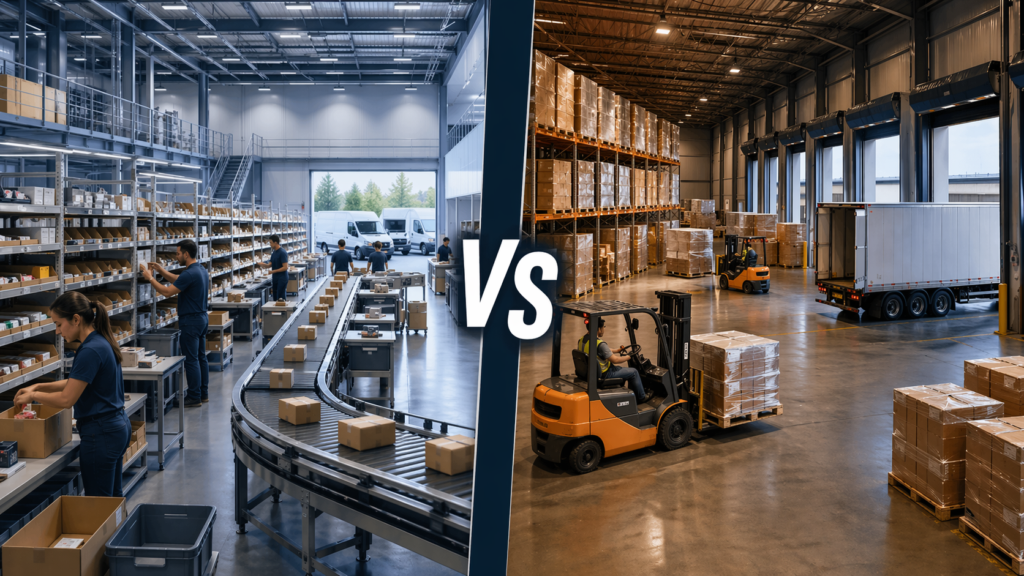
The difference between fulfillment centers and distribution centers lies in the end destination and quantities of goods. Fulfillment centers are built to process and ship orders to end customers (DTC or B2B), while distribution centers are designed to move bulk inventory between manufacturers, retailers, warehouses, and other nodes in the supply chain.
Fulfillment Centers Are Built For Speed, Flexibility & Final-Mile Delivery
A fulfillment center is typically optimized for fast, item-level handling. It supports high inventory turnover, often stores products for shorter periods, and typically offers value-added services such as kitting and returns management.
These facilities are also more likely to be located near major urban areas to support faster last-mile delivery.
Distribution Centers Are Built For Bulk Flow & Regional Distribution
Distribution centers, in contrast, are geared toward pallet-level movement and large-volume replenishment. They often use forklifts, wide aisles, and high-bay storage to handle freight more efficiently, and are usually positioned near ports, highways, rail hubs, or other major transportation routes.
Their focus is less on individual order customization and more on bulk transfer, consolidation, and regional distribution.
Fulfillment Center vs Warehouse
The primary difference between a fulfillment center and a warehouse is the activity level and intent. A warehouse is largely a static environment used for the long-term storage of bulk inventory. A fulfillment center is a highly active environment designed for short-term residency, where the goal is to move products in and out as fast as possible to meet customer demand.
Benefits Of Using A Fulfillment Center
For many businesses, the value of a fulfillment center goes beyond outsourcing storage and shipping. It creates a more agile operating model, one that can support growth, improve delivery performance, and reduce the internal burden of managing logistics in-house.
When fulfillment is part of a longer-term arrangement in which a provider manages multiple connected logistics functions through customized processes, systems, and performance targets, it can form part of a broader contract logistics model.
Scalability Without Building Your Own Infrastructure
One of the biggest advantages of using a fulfillment center is the ability to scale without having to invest in your own warehouse space, labor, systems, or shipping setup. As order volumes rise, fulfillment partners can usually absorb that growth more easily than an internal operation built around fixed capacity.
This is especially important for businesses with seasonal demand, promotional spikes, or expansion plans across new channels and regions.
Faster Shipping & Better Delivery Reach
Fulfillment centers are designed to move orders quickly, and location plays a major role in that. When inventory is positioned closer to customers, delivery times can shrink significantly, helping businesses meet rising expectations around speed and reliability.
That advantage becomes even more important in e-commerce, where shipping performance is no longer just an operational concern. It is part of the customer experience.
Lower Operational Overhead
Running fulfillment internally often means managing warehouse staff, equipment, software, packaging materials, carrier relationships, and process oversight. A fulfillment center helps shift much of that complexity to a dedicated operator.
Instead of building and maintaining every capability from scratch, businesses can access the services they need through a more flexible cost structure that is often easier to manage as volumes change.
Access To Technology, Expertise & Carrier Networks
Fulfillment centers typically operate with systems and workflows that would be difficult or expensive for many companies to develop on their own. That includes WMS platforms, barcode scanning, inventory visibility tools, routing logic, and established carrier relationships.
Just as importantly, they bring operational expertise. That can make a real difference in areas such as order accuracy, slotting strategy, shipping optimization, returns handling, and continuous process improvement.
Who Uses Fulfillment Centers?
Fulfillment centers are used by a wide range of businesses, but they are especially common among companies that need to move products quickly, manage fluctuating demand, and maintain visibility across multiple sales channels.
Ecommerce Brands
For e-commerce businesses, fulfillment centers provide the operational backbone needed to store inventory, process online orders, and ship directly to customers. They are particularly valuable for brands selling across their own website, marketplaces, and retail platforms at the same time.
Instead of managing fulfillment manually or relying on fragmented workflows, these businesses can centralize inventory and automate much of the order flow.
Omnichannel Sellers
Some companies need to support both direct-to-consumer and B2B or retail orders from the same inventory pool. Fulfillment centers can help manage that complexity by handling different order profiles within a coordinated system.
This is especially useful when a business needs to balance parcel shipments, store replenishment, marketplace orders, and returns without losing inventory accuracy.
Growing Companies That Need Flexibility
Fulfillment centers are also a strong fit for growing businesses that have outgrown basic storage and shipping setups but are not ready to operate their own logistics infrastructure. In these cases, outsourcing fulfillment can help reduce strain on internal teams while improving execution.
That flexibility can give businesses room to focus more on sales, product development, and customer relationships instead of day-to-day warehouse management.
Businesses With Specialized Fulfillment Requirements
Some products require more than simple storage and dispatch. Companies dealing with fragile items, branded packaging, kitting, serial tracking, product inspection, or reverse logistics often rely on fulfillment centers that can support those added requirements within the same workflow.
In that sense, fulfillment centers are not only for volume. They are also valuable for operational complexity.
How To Choose The Right Fulfillment Center & The Right Partner
Selecting a 3PL fulfillment partner is a strategic decision that should be based on several factors:
- Geographic Positioning: Choose your fulfillment facilities based on delivery speed and cost.
- Technology: Modern fulfillment centers leverage automated and AI capabilities to optimize their hands-on operations and forecast demand. In fact, highly automated fulfillment centers can deliver approximately 25% cost improvements during peak operations, ensuring your brand remains both competitive and profitable.
- Ability to Scale: Ensure the facility can handle sudden spikes in volume, especially during holiday seasons or promotions.
- Proven Reliability: Look for partners with a strong history of accuracy and established performance guarantees.
- Total Cost of Ownership: Review the full cost structure, including storage, inbound handling, pick-and-pack, shipping, returns, and account management fees.
- Specialized Handling: Make sure the facility can support your product’s specific requirements, whether that means lot tracking, serial number control, temperature-sensitive storage, or complex kitting.
- Performance Standards: You need partners that offer clear service-level commitments around order accuracy, fulfillment speed, and inventory accuracy, ideally backed by accountability measures.
- Compliance and Security: Verify that the facility follows strong operational, regulatory, and data security standards to help reduce risk and avoid costly disruptions.
- Communication and Fit: A strong fulfillment partner should be transparent, responsive, and aligned with your business goals, not just capable of moving inventory.
- Nearshoring Opportunities: Depending on your market, nearshoring may help reduce transit times, improve flexibility, and create cost advantages compared to distant fulfillment setups or, sometimes, local services.
Nearshore Success: Why A Fulfillment Center In Mexico Is The Key To More Efficient U.S. Shipping
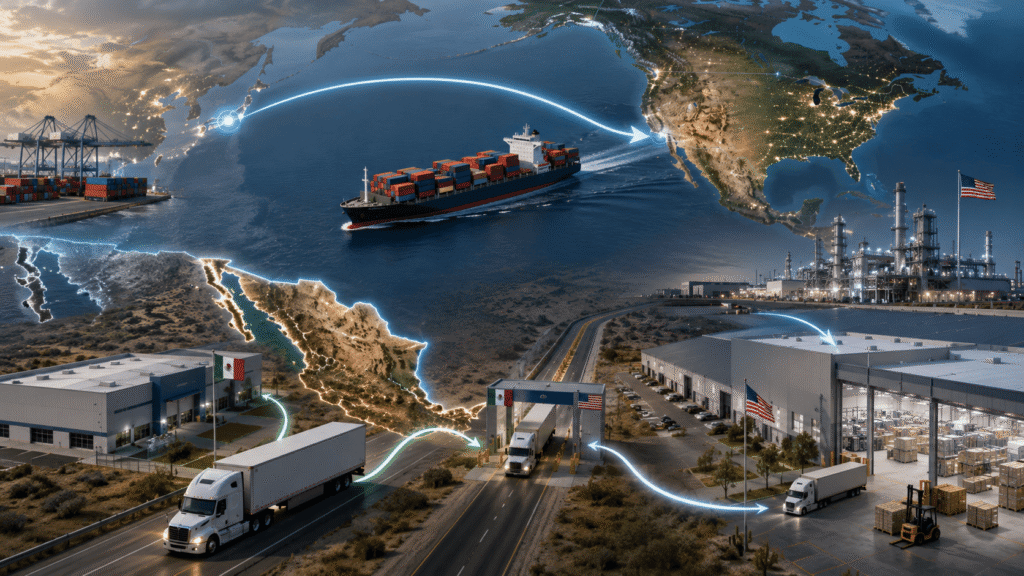
Establishing a fulfillment center in Mexico can be a strategic advantage for faster, more efficient fulfillment and shipping for U.S. brands. Its proximity to the southern states helps shorten transit, reduce lead times, and lower logistics costs without compromising service quality.
Border-Proximate Infrastructure That Speeds Up Delivery
Strategically located fulfillment hubs, especially in border cities like Tijuana, provide direct access to U.S. interstate networks, ports, and cross-border corridors. This creates a more connected logistics environment where warehousing and transportation work together more efficiently.
Cost Efficiency Without Sacrificing Control
Operating from Mexico can also unlock meaningful cost efficiencies, especially when IMMEX-aligned workflows are part of the model.
U.S. vendors may benefit from lower overhead costs, including rent, utilities, and labor, while IMMEX can support temporary import and export operations, helping reduce certain duty-related costs. At the same time, they can still access skilled operational support and reliable service levels.
For example, companies such as Walmart have used cross-border fulfillment operations in Mexicali to speed up deliveries and reduce costs for customers in the southern United States.
More than that, a Mexico-based fulfillment strategy can also strengthen supply chain resilience and flexibility by reducing reliance on long-distance overseas shipping and limiting exposure to disruptions caused by geopolitical upheavals.
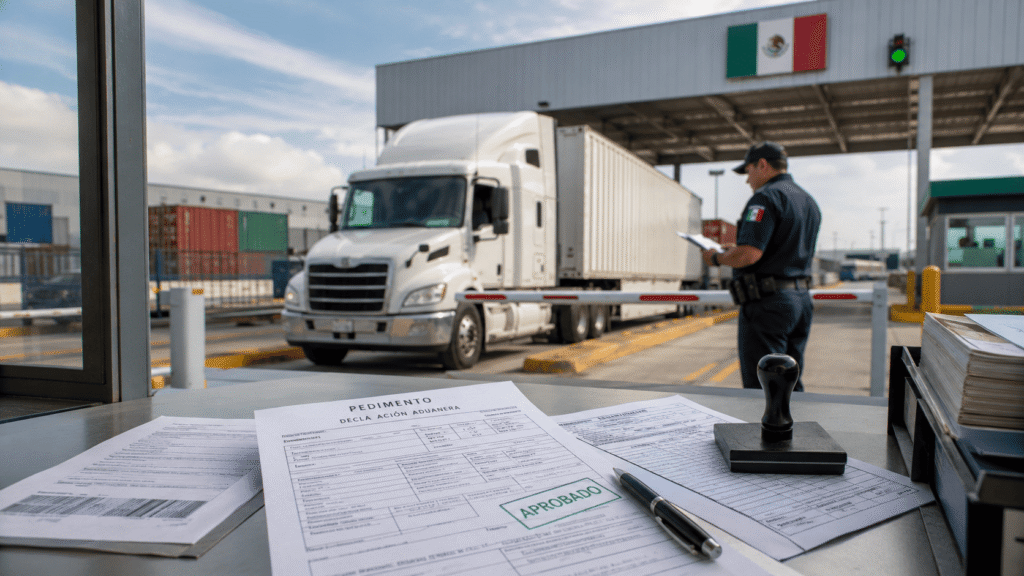
Under the USMCA framework, U.S. businesses that outsource fulfillment to Mexico may also benefit from smoother customs processes and preferential trade treatment, helping reduce cross-border friction.
Together, these advantages can support lower inventory requirements, stronger quality control, and a more flexible fulfillment model for North American shippers.
Turn Nearshoring Into A Competitive Edge With Loginam
For U.S.-based companies looking to nearshore with confidence, Loginam offers expert fulfillment services from Tijuana, just miles from the California border.
Our nearshore 3PL model helps you move faster, stay more flexible, and operate with greater control across your North American supply chain.
From warehousing and fulfillment to cross-border coordination and value-added offerings, Loginam supports shorter lead times, smoother cross-border execution, and more agile U.S.-bound operations.
When your fulfillment is closer to your market, the advantages go beyond lower costs. Nearshore with Loginam and turn proximity into performance. Request a quote today!
FAQs
What Is A Warehouse?
A warehouse is a large industrial facility designed primarily for the cost-effective, long-term storage of bulk inventory. Unlike active hubs, it is generally a static environment where movement occurs only when stock is added or sent out in bulk, typically serving wholesale or B2B fulfillment requirements.
What Is A Distribution Center?
A distribution center is a specialized hub focusing on moving bulk shipments to retail stores or other business locations. It serves as a vital transit point in the supply chain, and it’s optimized for the efficient movement of large quantities of finished goods to other logistical hubs or large-scale customers.
What Is A Fulfillment Distribution Center?
Often called a hybrid or omnichannel facility, it combines the roles of both models. It features dedicated areas to manage bulk shipments for retail replenishment while simultaneously processing high volumes of small, individual orders destined directly for end-consumers from a shared inventory pool.
What Is The Difference Between Distribution And Fulfillment?
The distinction lies in the destination and order profile. Distribution focuses on moving bulk quantities to retailers or other businesses. Fulfillment is optimized for processing a high volume of small, individual orders sent directly to consumers, prioritizing speed, accuracy, and the end-customer experience.
What Is The Amazon Fulfillment Center?
An Amazon Fulfillment Center is a specialized hub within its global network of 175+ facilities where sellers store inventory. Through the FBA program, Amazon uses these centers to handle the complete logistics process, enabling sellers to leverage Amazon’s scale and offer Prime benefits like rapid, free delivery to customers.
Does Amazon Have Fulfillment Centers In Mexico?
Amazon has 14+ fulfillment centers and over 40 total warehouses in Mexico. In 2025, it added a large AWS (Amazon Web Services) data center infrastructure to further support its logistics capabilities in the country, with expanded same-day delivery and AI-driven demand forecasting.
Why Is Amazon Moving To Mexico?
Amazon is not actually moving to Mexico. However, in 2025, Amazon launched the AWS Mexico (Central) Region with three high-tech data center zones in Querétaro. This $5B infrastructure hosts local data for regulated entities to meet residency laws and provide low-latency cloud services.
Integrated with its 14+ robotic fulfillment centers across Mexico, Amazon expands nationwide logistics and same-day delivery capabilities to 80+ cities to win in a booming market against rivals like Mercado Libre (Latin America’s leading e-commerce and fintech platform).
Can A Fulfillment Center Handle Returns?
Yes, many fulfillment centers also manage returns as part of their reverse logistics capabilities. That can include receiving returned items, inspecting their condition, deciding whether they should be restocked, refurbished, or discarded, and updating inventory records accordingly.
For businesses selling through e-commerce or omnichannel models, this is especially valuable because returns are not just an after-sales issue. They directly affect inventory accuracy, customer satisfaction, and overall operating efficiency.
Do Fulfillment Centers Store Inventory Long-Term?
Fulfillment centers can store inventory, but that is not their main purpose. They are designed for faster inventory turnover, frequent order processing, and continuous movement in and out of the facility.
If the primary goal is long-term bulk storage with limited handling activity, a warehouse is usually the more appropriate model. A fulfillment center is better suited to operations where products need to be picked, packed, shipped, and, in many cases, returned on an ongoing basis.
Do Small Businesses Need A Fulfillment Center?
Not always, but many small businesses benefit from using one once order volume, channel complexity, or delivery expectations become difficult to manage internally. A fulfillment center can help them scale without having to lease space, hire warehouse staff, or build their own shipping operation from scratch.
This is often most useful for growing e-commerce brands, subscription businesses, and sellers managing orders across multiple channels. In those cases, outsourcing fulfillment can free up time and resources while improving speed, accuracy, and inventory visibility.