
TL;DR
- Inventory management is the process of planning, tracking, storing, and replenishing stock so the right products are available without creating unnecessary excess.
- A strong inventory management process includes demand planning, replenishment, receiving, storage, fulfillment, auditing, and ongoing performance review.
- Good inventory management helps reduce carrying costs, prevent stockouts, improve operational efficiency, and support better inventory decisions.
- Best practices like inventory software, clear KPIs, cycle counts, and better supply chain visibility help keep inventory accurate and responsive.
Inventory management is no longer just a back-office function. For modern brands, it plays a central role in controlling costs, maintaining product availability, and keeping the supply chain running smoothly.
What Is Inventory Management?
Inventory management is the process of monitoring and controlling a company’s stock throughout its lifecycle. It tracks goods from the moment they are ordered, all through storage, to the point of sale. The goal is to keep inventory at the right level, enough to meet demand without overspending on storage or ending up with excess stock and waste.
Warehousing And Inventory Management: What’s The Difference?
While these terms are often used together, they refer to two distinct functions within your fulfillment operation. Inventory management is the broader strategic process of planning, tracking, and controlling stock levels across your network. Warehouse management, on the other hand, focuses on the day-to-day execution inside a physical facility, including storage, product handling (such as picking and packing), and space optimization.
Why Inventory Management Is Important
A streamlined inventory management process allows a business to balance the availability of products with the costs of holding them.
So, for example, if you lack sufficient stock, you face the risk of backorders, lost sales, missed delivery windows, and a drop in customer trust.
However, holding too much stock is also a major drain, as it ties up your capital and introduces various drawbacks: product damage, theft, items becoming obsolete before they can be sold – to name a few.
Benefits Of Inventory Management
Strong inventory management creates measurable advantages across the supply chain. It helps brands protect product availability, control operating costs, and make better decisions about how stock should move through the business.
Reduced Carrying Costs
When stock levels are aligned more closely with actual demand, businesses avoid tying up too much capital in slow-moving or excess inventory. That reduces pressure on warehouse space, lowers the risk of damage or obsolescence, and helps keep working capital available for other priorities.
Fewer Stockouts & Lost Sales
Inventory management also helps brands stay in stock when demand rises. By improving visibility into what is available, what is committed, and what needs to be reordered, teams can reduce backorders, protect delivery expectations, and avoid losing sales to competitors.
Better Operational Efficiency
A well-managed inventory system makes fulfillment more efficient from receiving through shipping. Products are easier to locate, replenishment becomes more predictable, and teams spend less time reacting to avoidable shortages or correcting preventable errors.
Better Visibility Into Inventory Performance
Inventory data becomes more useful when stock is tracked accurately and reviewed consistently. Businesses gain a clearer view of turnover, item movement, and replenishment needs, making it easier to spot inefficiencies and support more informed purchasing and planning decisions.
What Does Inventory Management Do?
Depending on the fulfillment environment, inventory management serves different priorities, from supporting coordinated wholesale distribution to enabling fast, accurate product availability for DTC sales.
B2B Fulfillment Runs On Inventory Precision
For B2B fulfillment brands, inventory management acts as the operational backbone of the supply chain. It synchronizes bulk procurement, production cycles, and multi-channel distribution.
By providing real-time SKU visibility, it prevents sales teams from over-committing on contractual SLAs and protects finance from capital tied up in dead stock.
Ultimately, it supports faster inventory turnover by placing the right stock with your 3PL partner or across your broader distribution network exactly when demand spikes.
In B2C, Inventory Drives Availability And Sales
For B2C brands, inventory management is the heartbeat of retail resilience and consumer satisfaction. It synchronizes high-volume sales across physical stores and e-commerce platforms to prevent stockouts that drive shoppers to competitors.
By leveraging predictive demand forecasting, brands can avoid the trap of aggressive markdowns and seasonal overstock. Ultimately, it protects profit margins by ensuring the right product is on the shelf or in the box at the exact moment of consumer impulse.
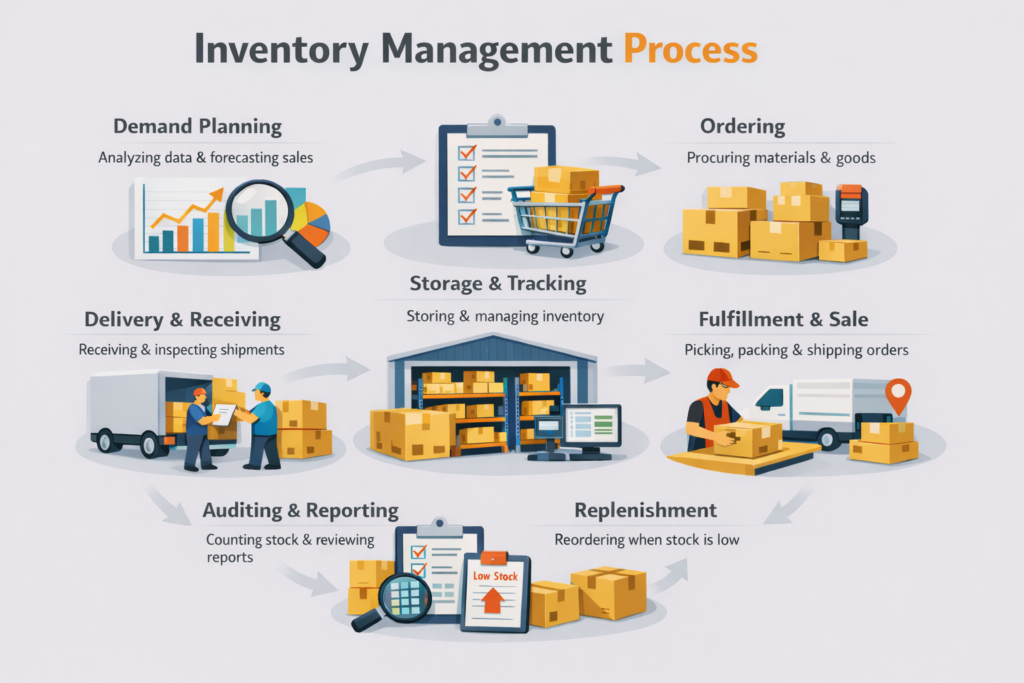
Inventory Management Process
To work well, inventory management usually follows a structured, multi-step process that helps businesses maintain stock accuracy, support fulfillment, and respond more effectively to changes in demand.
Demand Planning
The process starts with demand planning. At this stage, businesses analyze historical sales patterns, seasonality, market conditions, and customer behavior to estimate future inventory needs more accurately.
Without this step, stock decisions become reactive, increasing the risk of both overstocking and shortages.
Ordering & Replenishment
Once expected demand is clearer, the next step is ordering the right amount of inventory at the right time. This includes purchasing raw materials, components, or finished goods based on forecasts, current stock levels, lead times, and reorder thresholds.
A disciplined replenishment approach helps maintain continuity without creating unnecessary carrying costs.
Receiving & Inspection
When products arrive, they must be received carefully and checked against purchase orders and shipping documents. Teams verify quantities, inspect for visible damage, and confirm that the goods match the expected specifications.
This step matters because inventory errors often begin at the receiving stage, long before they create downstream problems in storage, picking, or fulfillment.
Storage & Inventory Tracking
After receiving, inventory must be recorded correctly in the system and placed in the appropriate storage locations. This is where inventory control and warehouse execution start to overlap more directly.
Clear SKU records, designated bin locations, and accurate stock updates make products easier to trace, count, and retrieve when orders come in.
Fulfillment & Stock Movement
As orders are processed, inventory moves out of storage and into picking, packing, and shipping workflows. Every movement should be reflected in the inventory system so available stock remains accurate across channels.
This is especially important for businesses handling high order volumes or selling across multiple sales platforms, where even small timing gaps can lead to stock discrepancies.
Auditing & Stock Verification
Inventory records should also be checked against physical stock on a regular basis. Cycle counts, spot checks, and periodic audits help businesses catch discrepancies early and correct issues before they affect customer orders or purchasing decisions.
This step strengthens stock accuracy and helps uncover problems such as shrinkage, misplacement, or receiving errors.
Reporting & Continuous Improvement
The final step is using inventory data to improve future decisions. Reporting helps teams evaluate turnover, stock accuracy, service levels, and replenishment performance over time.
With better reporting, businesses can refine reorder points, adjust inventory policies, and make the overall process more efficient and resilient.
Inventory Management Best Practices
Effective inventory control comes down to the systems, routines, and habits that help brands stay accurate, responsive, and cost-efficient while improving visibility and decision-making across the supply chain.
Here are some things you can do:
Use Data-Driven Demand Planning
By analyzing historical sales figures alongside current market trends and seasonal shifts, you can predict future requirements more accurately, staying in the sweet spot between having enough stock to satisfy customers and not overcommitting your capital.
Perform Regular Cycle Counts
Rather than waiting for a massive annual audit, frequent counts of specific subsets of stock help you identify and fix record discrepancies in real time. Cycle counts build confidence in your data and help uncover issues like inventory shrinkage or misplacement early.
Enforce FIFO/FEFO Inventory Rotation
To mitigate the risk of items becoming shelf-worn or unsellable, you must ensure the oldest or earliest-expired stock is dispatched first. Depending on the type of inventory, the FIFO (First In First Out) and FEFO (First Expired First Out) approaches are essential for brands dealing with perishable or time-sensitive goods.
Monitor Key Inventory KPIs
You should always track metrics like turnover rates, order accuracy, and fill rates to identify hidden inefficiencies in your supply chain. With such data-driven insights, you can see exactly where operational issues are affecting costs, service levels, and your bottom line.
Collaborate Closely With Suppliers
Sharing your forecasts and sales trends with vendors can lead to more reliable replenishment and better pricing terms.
Clear communication also helps suppliers prioritize your orders during disruptions and adjust lead times more quickly when conditions change. Over time, this kind of transparency creates stronger strategic partnerships, often opening the door to volume discounts or more flexible payment arrangements as your business grows.
Use Inventory Software For Real-Time Visibility And Automation
Modern brands must have robust cloud-based inventory management software that serves as a single source of truth across all locations. Teams can thus improve stock accuracy and make faster, better-informed decisions across the supply chain.
Inventory Management Strategies
Here are some of the most important inventory management strategies for optimizing your stock:
ABC Analysis
The ABC analysis technique prioritizes your oversight by categorizing stock into three groups based on their revenue impact:
- Group A items are your high-value goods that typically account for 80% of your earnings, requiring the most rigorous tracking and frequent audits.
- Group B items hold moderate value.
- Group C items are low-value, high-volume products that require the least intensive control.
This categorization helps you focus your time, capital, and controls where they can deliver the greatest operational and financial return.
Just-In-Time (JIT) Fulfillment
JIT supports lean operations by ordering or producing goods only when confirmed customer demand exists. This model minimizes storage, insurance costs, and waste.
However, JIT requires absolute precision, as it carries a high risk of stockouts if your supply chain experiences even minor disruptions or lead-time volatility.
Economic Order Quantity (EOQ)
This is a mathematical approach used to identify the ideal batch size for your orders.
By balancing the cost of placing an order against the cost of holding inventory, EOQ helps ensure you are not ordering too frequently or sitting on expensive, stagnant stock. It supports healthier cash flow by identifying the precise order volume that minimizes total inventory-related costs.
EOQ is especially useful for items with stable demand, where replenishment can be planned more accurately and with less guesswork.
Cross-Docking
To accelerate the supply chain, cross-docking is a logistics technique that moves products directly from the receiving dock to outbound shipping with little to no time spent in storage. This is a premier strategy for handling time-sensitive or high-volume items that need to reach the customer immediately.
Vendor-Managed Inventory (VMI)
Also known as supplier-managed inventory, this collaborative model shifts the responsibility of restocking to your vendor. By sharing your sales data and historical trends, the supplier monitors your stock levels and initiates replenishment automatically to ensure you never run out of critical items.
Safety Stock Buffering
This serves as your “just-in-case” reserve, maintaining extra inventory to protect against unexpected spikes in demand or delivery failures from suppliers. The correct level of safety stock is calculated based on lead times and demand variability to ensure customer satisfaction isn’t compromised during disruptions.
Materials Requirement Planning (MRP)
Primarily used in manufacturing, MRP uses sales-forecast data to determine the precise quantity and timing of materials needed for production. It synchronizes the arrival of components with production schedules, preventing assembly line stalls and the accumulation of excess raw materials.
Inventory Management Examples
There are countless examples that show how good or poor inventory management can affect not only a brand’s profitability, but also its future sales and reputation.
Excess Fashion Stock Affects Brand Perception
Fashion and retail offer one of the clearest examples of why inventory management matters, since fast-moving trend cycles can turn excess stock into a brand liability. The way a brand handles that excess inventory can influence perceptions of wastefulness, brand image, and future purchase intent.
A recent study found that certain destructive methods, such as incinerating unsold goods, were seen as highly wasteful and damaged brand perception.
By contrast, recycling, donation, and discounting were generally viewed more positively because they signaled less waste. One exception appeared in some luxury settings, where discounting could weaken perceived exclusivity, even if it was still viewed as less wasteful than destroying stock.
Supplier Diversification Protects Inventory Continuity
Supplier diversification offers another strong example of the importance of inventory management, especially in industries that rely heavily on imported materials.
Up to a few months ago, many enterprises in Vietnam, especially SMEs, remained vulnerable to supplier concentration risk because they relied too heavily on China for critical inputs.
Specifically in the textile and garment sector, where roughly 50–55% of raw materials were imported from China, strict Chinese policies and resulting port congestion contributed to production delays and delivery disruptions.
That pressure has pushed many businesses to seek new suppliers to reduce the risk of inventory shortages tied to overreliance on a single source.
This shows that stock issues do not always begin inside the warehouse. They can also start upstream, when procurement concentration slows replenishment, drains safety stock, and puts fulfillment performance under pressure.
Strong inventory management, therefore, depends not only on accurate stock control but also on a supplier base that supports continuity and resilience.
Turn Inventory Strategy Into Cross-Border Advantage
Inventory management works best when the strategy is backed by the right operational support.
Located on the U.S.-Mexico border, Loginam offers streamlined warehousing and inventory control services that help brands keep stock accurate, available, and moving efficiently.
For U.S. manufacturers and distributors, that support becomes even more valuable in cross-border operations, where inventory visibility, compliance, and coordination can directly affect speed, cost, and continuity.
Strong inventory management is not just about tracking stock. It is about building an operation that stays accurate and responsive when real-world pressure hits, no matter which side of the border your operation is on.
With the right setup, inventory stops being a liability and starts becoming an advantage.
Make every unit count with Loginam. Contact us today!
FAQs
What Are The 4 Types Of Inventory Management?
The 4 primary types of inventory management include:
- Just-in-Time (JIT), which schedules orders for immediate use
- Materials Requirement Planning (MRP), which uses sales forecasts
- Economic Order Quantity (EOQ), which determines ideal batch sizes
- ABC Analysis, which prioritizes stock by revenue impact
What Are The 5 Stages Of The Inventory Management Process?
The fundamental inventory management process involves five core stages:
- Acquisition of items from suppliers
- Organized storage of goods
- Precise tracking of all stock movements
- Distribution or final sale to customers
- Ongoing optimization of stock levels to maintain a balance between supply and demand.
How Does Inventory Management Software Work?
Inventory software acts as a centralized “brain” for your supply chain. It integrates real-time data from sales, procurement, and shipping into a single source of truth. By using API syncs, it tracks SKU movements instantly, automates reorder points, and uses predictive analytics to forecast demand. This eliminates manual errors and ensures optimal stock levels across all channels.
What Is Inventory And Warehouse Management?
Inventory and warehouse management is the process of tracking stock levels, storing goods efficiently, and moving products accurately through a facility. It helps businesses maintain availability, reduce waste, improve order accuracy, and keep operations running smoothly from receiving to shipping.
What Is The Main Goal Of Inventory Management?
The main goal of inventory management is to keep the right amount of stock available at the right time while avoiding unnecessary storage costs, waste, and stock-related disruptions. In practice, that means balancing product availability with working capital, so the business can meet demand without overcommitting resources.
What Is The Difference Between Inventory Management And Inventory Control?
Inventory management is the broader process of planning, tracking, ordering, storing, and replenishing stock across its lifecycle. Inventory control is narrower. It focuses more specifically on maintaining stock accuracy, preventing shortages or excess, and ensuring inventory is handled properly within the operation. In simple terms, inventory control is one part of overall inventory management.
Why Is Inventory Accuracy So Important?
Inventory accuracy is important because every planning, purchasing, and fulfillment decision depends on it. When stock records are wrong, businesses may reorder too early, run out unexpectedly, delay shipments, or promise inventory they do not actually have. Accurate inventory data helps protect service levels, reduce waste, and support better decision-making across the supply chain.
Which Businesses Need Inventory Management The Most?
Any business that stores, sells, distributes, or uses physical goods needs inventory management, but it becomes especially important for retailers, e-commerce brands, manufacturers, wholesalers, and distributors. In these environments, stock availability, order timing, and replenishment accuracy directly affect customer satisfaction, operating costs, and overall supply chain performance.
What Problems Can Poor Inventory Management Cause?
Poor inventory management can lead to stockouts, overstocking, fulfillment delays, excess carrying costs, and avoidable write-offs. It can also reduce visibility across the supply chain, making it harder to respond to changing demand or supplier issues. Over time, those problems affect customer trust, profit margins, and operational stability.
Can A 3PL Help With Inventory Management?
Yes, a 3PL can support inventory management by improving stock visibility, storage organization, order flow, and replenishment coordination across your operation. For brands working across multiple channels or managing cross-border logistics, that support can make inventory more accurate, more responsive, and easier to control as demand changes.